
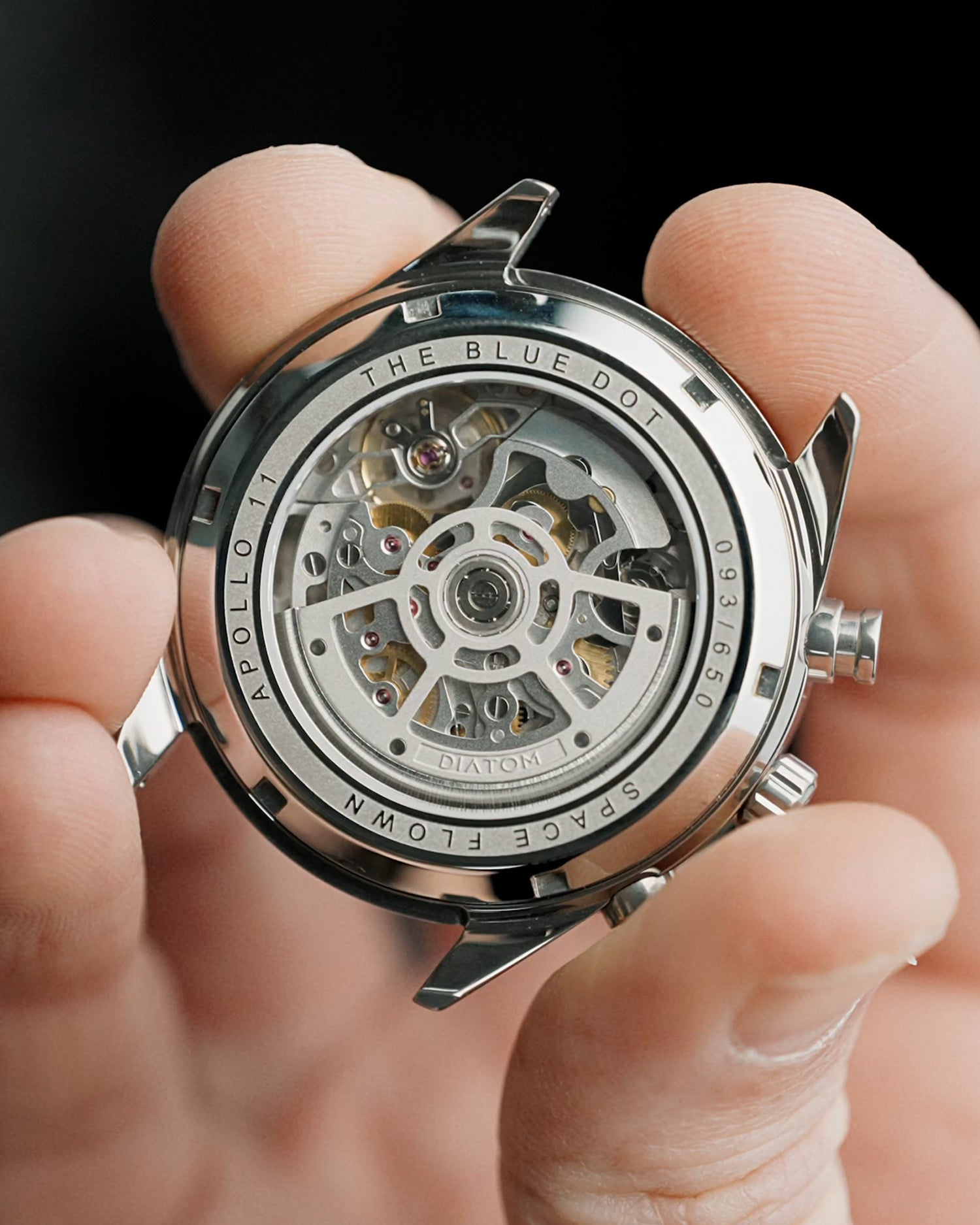
Nothing made its way onto a rocket during the Apollo programme without undergoing rigorous testing beforehand, and astronaut watches were certainly no exception. Here at Diatom, we employ the exact same ethos to quality control, ensuring that every one of our components is capable of surviving the extremes of a journey to the edge of space. This article takes a peek behind the curtain to reveal how we select and certify our automatic watch movements for use in one of the harshest environments known to man.

How do automatic watch movements cope with lack of pressure?
Launching an automatic watch movement into space and returning it unscathed is truly no mean feat. For starters, once our Diatom crafts reach their peak altitude of well over 120,000 feet, they’re actually floating above 99.5% of the Earth’s atmosphere. The incredibly low pressures experienced in this near-vacuum environment can cause gear lubricants in certain movements to ‘outgas’, losing various compounds into the surroundings via evaporation and permanently degrading their vital friction-reducing properties. Our movements are carefully selected for their use of lubricants which can handle low pressure environments.

Do Automatic Movements Work in Freezing Temperatures?
It’s not just low pressures that automatic movements have to deal with, though; there’s also the issue of wild temperature swings to overcome. With the furthest reaches of the upper stratosphere falling to an icy -70°C, a watch’s internals will suffer from thermal contraction, with different components affected to varying degrees depending on their properties. This can interfere with some movement’s delicate tolerancing, causing subpar gear meshing, increased friction and in some cases complete mechanical failure. Again at Diatom we carefully select movements which retain their tolerances, even following experiences of extreme temperature.

Lab Testing our Watch Movements
The first port of call in the certification process is to simulate these extreme temperature and pressure regimes in the lab, and our engineers employ a range of state-of-the-art apparatus to put the movements through their paces. This includes subjecting them to carefully-calculated pressure profiles within a bespoke vacuum chamber and cooling them to space-comparable temperatures inside an industrial ultra-low temperature freezer. The lab procedures then culminate in a final chronograph healthcheck, using a timegrapher to determine the movement’s amplitude, beat rate and beat error via analysis of its sonic emissions.

Space Flown Automatic Watches
Lab procedures aside, the ultimate test comes once we launch our watches into space. Here, the movements are subjected to sub-zero temperatures and near-zero pressures simultaneously, revealing any compounding effects of the two. With the launch complete, it’s back to the timegrapher to determine the flight’s effects on the movement’s performance, before officially space-certifying calibres that obtain a clean bill of health.

Space-Certified Timepieces
Here at Diatom, we go to great lengths to space-certify our movements through a series of lab-based and real-world assessments. Each assembled watch then undergoes a multi-step quality control process to determine its performance both before and after its journey to the edge of space. From movements and dials to cases and straps, we comprehensively test every Diatom component to ensure our watches can withstand the rigours of those who seek the extraordinary.