
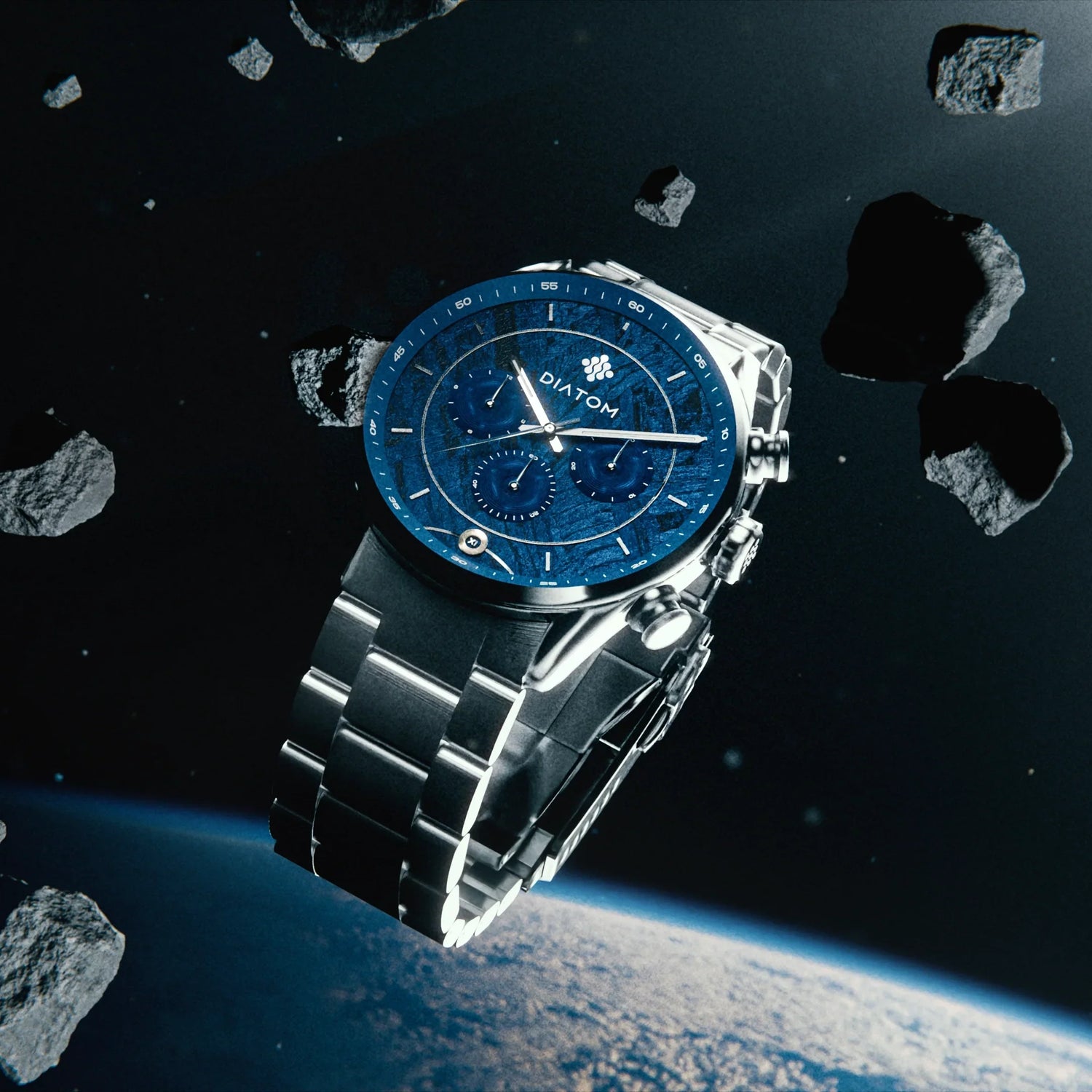
When it comes to space watches, few objects capture the imagination quite like the timepieces that have journeyed beyond Earth's atmosphere. From the legendary NASA watches worn during the Apollo missions to modern interpretations that celebrate humanity's greatest adventure, these watches represent the perfect fusion of precision engineering and cosmic exploration.

The Legacy of NASA Watches and Space Exploration
The story of space watches begins in the 1960s when NASA needed reliable timepieces for the Apollo program. The rigorous testing process led to the certification of watches that could withstand extreme conditions: temperature fluctuations from -18°C to +93°C, pure oxygen environments, and the vacuum of space. These NASA-approved watches became essential tools for astronauts, timing everything from moonwalks to critical spacecraft maneuvers.
The Apollo 11 mission in 1969 marked humanity's first steps on the lunar surface, and the watches worn during this historic moment became legendary. But it wasn't just the watches themselves that made the journey since every component, every material had to be carefully selected to survive the harsh environment of space.

What Makes a True Space Watch?
Authentic space watches share several key characteristics:
Extreme temperature resistance - capable of functioning in both the heat of direct sunlight and the freezing darkness of space
Pressure resistance - must maintain accuracy in vacuum conditions
Material durability - components must resist degradation from radiation and extreme conditions
Manual winding capability - essential when power sources are limited
Legibility - clear dial and luminous markers for quick reading in any lighting condition

The Remarkable Story of Kapton Foil in Space Exploration
Among the many materials that made the Apollo missions possible, Kapton foil stands out as one of the most crucial innovations. This polyimide film, developed in the 1960s, became essential to NASA's space program due to its extraordinary properties. Kapton can withstand temperatures ranging from -269°C to +400°C without losing its structural integrity, making it perfect for the extreme thermal fluctuations of space.
During the Apollo 11 mission, Kapton foil served multiple critical functions. It protected sensitive electronics from radiation, insulated components from temperature extremes, and provided a lightweight yet durable barrier against the harsh space environment. The distinctive gold-colored material became visible on the lunar module, command module, and various instruments that made the moon landing possible.
Ancient Cosmic Materials: When Watches Meet Deep Time
While space exploration represents humanity's future, some of the most compelling space watches incorporate materials that connect us to the distant past. The Earth itself is approximately 4.5 billion years old, and certain geological formations have remained relatively unchanged for over a billion years.
These ancient rocks, formed in Earth's prehistoric oceans and volcanic activity, carry within them the story of our planet's evolution. Some contain microscopic fossils, mineral structures formed under immense pressure, and crystalline patterns that developed over geological timescales that dwarf human history. When incorporated into watch dials, these materials create a unique connection between deep time and precision timekeeping.

Diatom Watches: Where Apollo History Meets Ancient Earth
At Diatom, we've created something truly unique in the world of space watches. Our timepieces contain actual materials from the Apollo 11 mission and Earth's ancient past.
Each Diatom watch features authentic Kapton foil that was part of the Apollo 11 mission to the moon. This is the real thing, carefully preserved and incorporated into our watch design. When you wear a Diatom watch, you're wearing a piece of history that traveled to the moon and back, a material that protected astronauts Neil Armstrong, Buzz Aldrin, and Michael Collins on humanity's greatest adventure.
But we didn't stop there. Our watch dials are crafted from billion-year-old rock, creating a stunning juxtaposition between humanity's technological achievement and Earth's geological timeline. Each dial is unique, with natural variations in color, texture, and pattern that make every Diatom watch one-of-a-kind. The ancient stone serves as a reminder that while we've only recently ventured into space, we come from a planet with an incomprehensibly vast history.

The Future of Space Watches
As commercial space travel becomes reality and missions to Mars are planned, the next generation of space watches is already being developed. However, the Apollo-era timepieces and the materials from those historic missions remain the gold standard. The Kapton foil that protected Apollo astronauts represents a moment when humanity first left its planetary cradle, and preserving these materials in modern timepieces ensures that legacy continues.
More Than Just Timekeeping
Space watches like those from Diatom transcend their function as timepieces. They're conversation starters, historical artifacts, and wearable reminders of human potential. By combining authentic Apollo 11 Kapton foil with billion-year-old rock dials, we've created watches that span from Earth's ancient past to humanity's space-age future.
Whether you're a space enthusiast, a watch collector, or someone who appreciates the intersection of history and craftsmanship, a space watch offers something special. And when that watch contains actual materials from the moon landing and rocks formed a billion years ago, it becomes a piece of cosmic history you can wear on your wrist.

Discover the Diatom Earthrise collection and own a piece of space history combined with Earth's ancient story. Each watch is a unique testament to human exploration and geological wonder.