
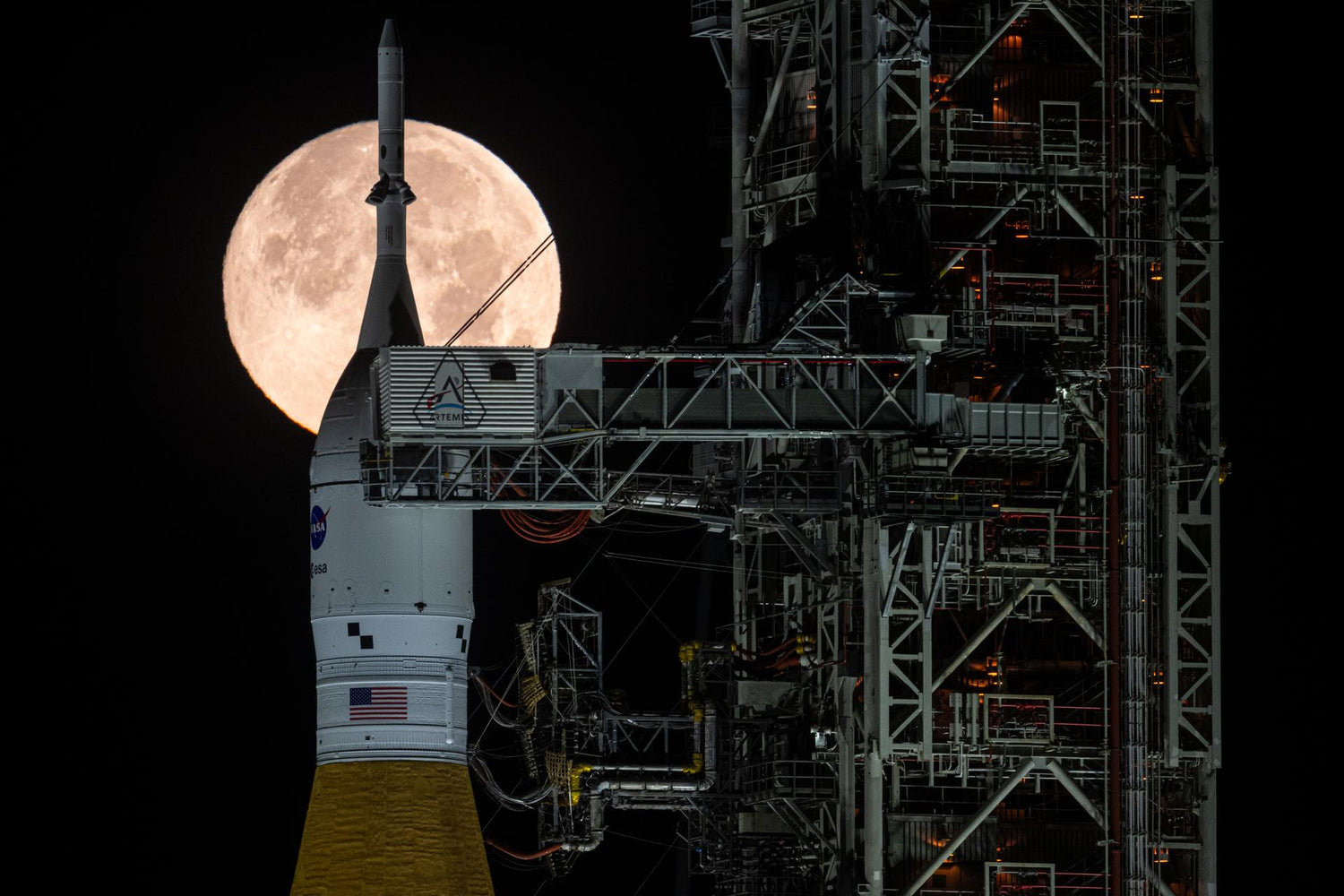
On April 1st 2026, NASA's Artemis II mission lifted off from Kennedy Space Center in Florida. The four astronauts aboard the Orion spacecraft – Reid Wiseman, Victor Glover, Christina Koch and Jeremy Hansen – then travelled farther from Earth than any human has ever gone before. Ten days and almost 700,000 miles later, their journey culminated in a dramatic splashdown in the Pacific Ocean, marking the completion of the first manned journey to the Moon since the end of the Apollo program some 50-odd years ago.

Breaking down the Artemis program
The Artemis program is NASA's ambitious multi-phase campaign that aims to return astronauts to the Moon and establish a sustainable lunar presence by the end of the decade. Named after the Greek goddess of the Moon – and twin sister of Apollo – Artemis will usher in a new generation of lunar exploration and set the scene for humanity’s continued exploration of the solar system.

Artemis I: Testing the waters
The program began with Artemis I, an uncrewed test flight that sent the Orion spacecraft on a 25-day voyage around the Moon. This mission was critical to validate a range of new spacecraft systems, including the craft’s heat shield, which had to withstand temperatures of nearly 5,000 degrees Fahrenheit during atmospheric reentry. Fortunately, the mission was a success and proved that NASA's new Space Launch System (SLS) – the most powerful rocket ever built – was capable of carrying humans beyond Earth orbit.

Artemis II: Manned lunar flyby
Artemis II was the first crewed test flight of NASA's renewed lunar program and the first time humans have travelled beyond low Earth orbit since Apollo 17 in 1972. The crew flew aboard the Orion spacecraft to initiate a flyby that brought them approximately 7,500 kilometres above the Moon's surface, before travelling back to Earth on a free-return trajectory. The mission successfully validated Orion's life support systems with a crew aboard for the first time, while providing a chance to test critical navigation systems and manual piloting operations – laying the groundwork for what comes next.

Artemis III: Orbital docking manoeuvres
Artemis III, currently scheduled for late 2027, will conduct orbital docking manoeuvres with a number of commercially-developed lunar landing solutions, marking a dramatic departure from traditional NASA-designed systems. The vehicle ultimately chosen will join the Artemis IV flight and transport astronauts from lunar orbit to the surface of the Moon, offering far more interior volume than the cramped Apollo lunar module.

Artemis IV: Boots on the Moon
Planned to take place in 2028, this will be the moment the world has been waiting for since 1972. As well as Artemis IV allowing humans to return to the lunar surface, it will also mark the first time a woman and a person of color have landed on the Moon. The mission will specifically target the Moon's south polar region, which is an area that was never explored by the previous Apollo astronauts. The hope is that the pole’s permanently shadowed craters might harbor deposits of water ice, a resource that could be just the ticket for long-term lunar habitation and deep space exploration.

Your connection to space exploration
Like many of you, we watched in awe as the brave Artemis II crew hurtled through space at almost 40,000 KPH towards our nearest celestial neighbor. But here at Diatom, space exploration isn't just something we just admire from a distance. Quite simply, it's the foundation of everything we do. We source genuine mission-flown artifacts, preserve them through a variety of lab techniques and incorporate them into our watches – continuing the legacies of a plethora of iconic spacecrafts. The connection to space doesn’t end there though, as we also launch our timepieces on a journey to over 100,000 feet above the Earth, imbuing every single watch with the boundless spirit of the space age.
Check out our range of space-flown watches here and secure your very own cosmic connection today.